Content Warnings
- 🟡 30/100 Brief scene of partial nudity when a character is bathing.
- 🟢 10/100 Characters are seen smoking a pipe, which may be tobacco.
- 🔴 70/100 Battle scene with gunfire and soldiers being shot.
- 🔴 80/100 Intense scene with hand-to-hand combat and injuries.
- 🟡 50/100 Animal hunting scene with blood shown.
- 🟢 20/100 Mild cursing by a soldier.
- 🟢 20/100 Brief use of mild profanity.
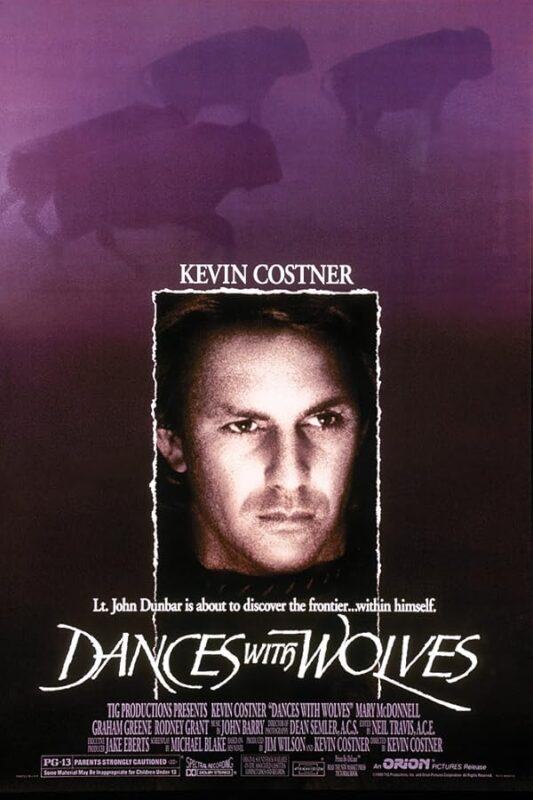
Details for Dances with Wolves (1990)
What is the plot of Dances with Wolves?
Dances with Wolves is a 1990 epic Western film that follows the story of Lieutenant John J. Dunbar, a Union Army officer who befriends a tribe of Lakota Indians during the American Civil War. After being assigned to a remote outpost on the western frontier, Dunbar gradually integrates into the Lakota community, adopting their customs and way of life, which leads to conflict with the encroaching U.S. military.
Who directed and starred in Dances with Wolves?
Dances with Wolves was directed by Kevin Costner, who also starred in the film as Lieutenant John J. Dunbar. The movie features notable performances by Mary McDonnell as Stands With A Fist, Graham Greene as Kicking Bird, and Rodney A. Grant as Wind In His Hair.
Did Dances with Wolves win any Academy Awards?
Yes, Dances with Wolves won seven Academy Awards, including Best Picture, Best Director for Kevin Costner, Best Adapted Screenplay, Best Cinematography, Best Film Editing, Best Original Score, and Best Sound. It was a critical and commercial success.
What is the significance of the title Dances with Wolves?
The title Dances with Wolves refers to the name given to Lieutenant John J. Dunbar by the Lakota tribe after they observe him playing with a wolf he befriends. The name symbolizes his growing connection with the Lakota people and their culture, as well as his departure from his former identity as a Union soldier.
How was the portrayal of Native Americans in Dances with Wolves received?
Dances with Wolves was praised for its sympathetic and respectful portrayal of Native Americans, particularly the Lakota Sioux. The film used authentic Lakota dialogue (with subtitles) and involved Native American actors and consultants to ensure cultural accuracy. This was a significant departure from many earlier Westerns that stereotyped or marginalized Indigenous characters.