Content Warnings
- 🟡 40/100 Brief scene with implied sexual activity.
- 🟡 30/100 Discussion about infidelity and sexual relationships.
- 🟢 20/100 Characters drinking alcohol in a social setting.
- 🟢 10/100 Mention of drug use in a conversation.
- 🟡 30/100 A character slaps another character in a heated argument.
- 🟢 20/100 Intense verbal confrontation with threats.
- 🔴 80/100 Use of the word 'f***' in a rant.
- 🔴 70/100 Multiple instances of strong language including 's***' and 'a******'.
- 🔴 80/100 Frequent use of profanity in a workplace argument.
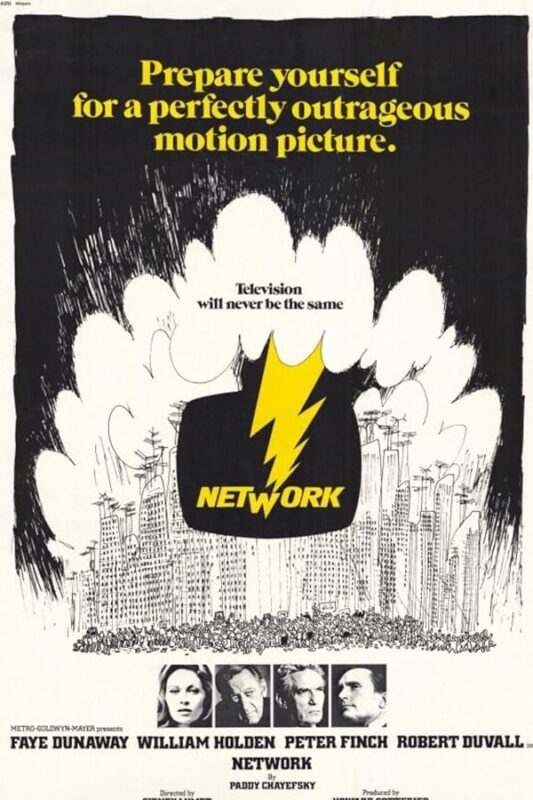
Details for Network (1976)
What is the plot of the movie Network (1976)?
Network (1976) is a satirical drama that explores the world of television news and media exploitation. The story revolves around Howard Beale, a veteran news anchor who suffers a mental breakdown on air and becomes a ratings sensation. The network capitalizes on his instability, blurring the lines between news and entertainment, while other characters grapple with ethical dilemmas and corporate greed.
Who are the main actors in Network (1976)?
The movie stars Peter Finch as Howard Beale, Faye Dunaway as Diana Christensen, William Holden as Max Schumacher, and Robert Duvall as Frank Hackett. These actors deliver powerful performances that drive the film's intense narrative.
Did Network (1976) win any Academy Awards?
Yes, Network (1976) won four Academy Awards: Best Actor (Peter Finch, posthumously), Best Actress (Faye Dunaway), Best Supporting Actress (Beatrice Straight), and Best Original Screenplay (Paddy Chayefsky). It was also nominated for several other categories, including Best Picture and Best Director.
What themes does Network (1976) explore?
Network (1976) critiques the sensationalism and commercialization of news media, corporate greed, and the erosion of journalistic integrity. It also delves into themes of mental health, exploitation, and the blurred lines between reality and entertainment.
Who directed Network (1976)?
Network (1976) was directed by Sidney Lumet, a renowned filmmaker known for his work on socially relevant and critically acclaimed movies such as 12 Angry Men (1957) and Dog Day Afternoon (1975).