Content Warnings
- 🟡 50/100 Brief scene with implied sexual activity.
- 🟡 30/100 Partial nudity in a non-sexual context.
- 🟡 60/100 Characters shown smoking marijuana.
- 🔴 80/100 Drug dealing and use of cocaine depicted.
- 🔴 90/100 Graphic shooting scene with blood.
- 🔴 95/100 Intense gang violence and multiple deaths.
- 🔴 85/100 Child character involved in violent act.
- 🔴 70/100 Frequent use of strong profanity.
- 🟡 60/100 Racial slurs and offensive language.
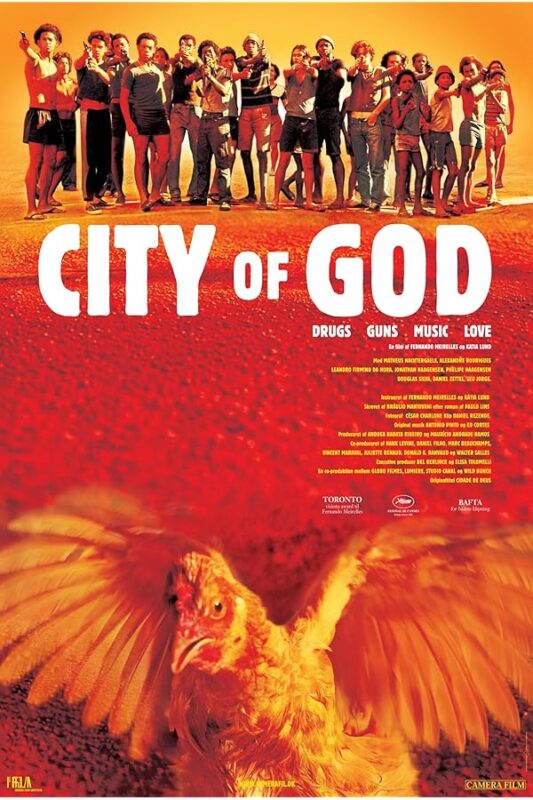
Details for Cidade de Deus (2002)
What is the plot of Cidade de Deus (2002)?
Cidade de Deus (City of God) is a Brazilian crime drama that follows the lives of several characters growing up in the violent slums of Rio de Janeiro. The story spans the 1960s to the 1980s, focusing on the rise of organized crime and the impact it has on the community, particularly through the perspectives of Rocket, an aspiring photographer, and Li'l Zé, a ruthless gang leader.
Who are the main actors in Cidade de Deus?
The main actors in Cidade de Deus include Alexandre Rodrigues as Rocket (Buscapé), Leandro Firmino as Li'l Zé (Zé Pequeno), and Matheus Nachtergaele as Benny. Kátia Lund co-directed the film but did not act in it.
Is Cidade de Deus based on a true story?
While Cidade de Deus is not a true story, it is based on real-life events and inspired by the 1997 novel of the same name by Paulo Lins, who grew up in the actual Cidade de Deus favela in Rio de Janeiro. The film portrays the harsh realities of life in the slums, including gang violence and poverty.
What awards did Cidade de Deus win?
Cidade de Deus received widespread critical acclaim and won numerous awards, including four Cinema Brazil Grand Prizes and an Academy Award nomination for Best Director (Fernando Meirelles), Best Cinematography, Best Film Editing, and Best Adapted Screenplay. It also won the BAFTA Award for Best Editing.
Why is Cidade de Deus considered an important film?
Cidade de Deus is considered an important film for its raw and unflinching portrayal of life in Brazilian favelas, its innovative cinematography, and its gripping narrative. It brought international attention to the social issues in Rio de Janeiro's slums and is often praised for its authenticity, as many of the actors were non-professionals from similar backgrounds.